



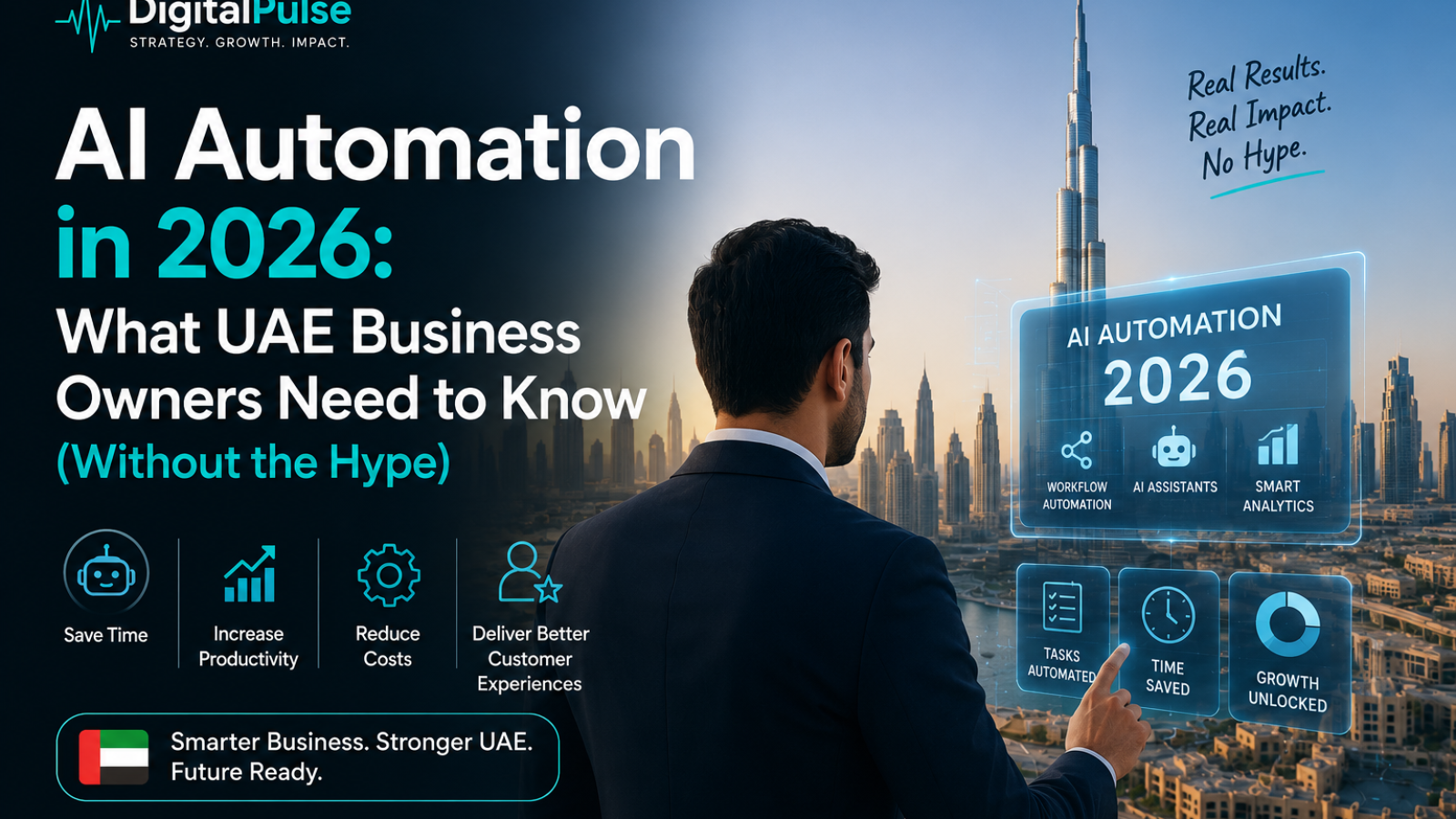
Every week there’s a new article, a new conference, a new LinkedIn post telling business owners that AI is going to change everything. And it will. In many industries and many workflows, it already is. But the gap between the hype and the practical reality of implementing AI in a small or medium-sized UAE business is enormous — and most of the available information isn’t helping.
This article is not about the future. It’s about what AI automation is doing for UAE businesses right now, in 2025, what it actually costs, how long it takes to implement, and how to start without wasting money on tools you don’t need.
What AI Automation Actually Means for an SME
When most business owners hear ‘AI automation’, they imagine something either futuristic and unaffordable, or a chatbot that answers basic questions. The reality is more useful and more accessible than either extreme.
In practical terms, AI automation for an SME in the UAE means using software to handle repetitive, rule-based tasks that currently require human attention. The most common and highest-impact applications include:
Customer follow-up and lead nurturing
When a prospective customer fills in an enquiry form on your website, sends a WhatsApp message, or submits a booking request, what happens next? In most businesses, someone manually reviews it and either replies or forgets. AI automation means that follow-up happens instantly, consistently, and at scale — a personalised response within seconds, a reminder three days later if there’s no reply, and an escalation to a salesperson if the prospect engages.
Invoice processing and accounts payable
Manually processing supplier invoices — checking them against purchase orders, entering data into accounting systems, routing for approval — takes significant time and introduces errors. AI tools can extract data from invoices automatically, match them to purchase orders, flag discrepancies, and route approvals without human intervention for routine transactions.
Inventory alerts and reordering
A retail or pharmacy business that manually checks stock levels is always reacting to shortages rather than preventing them. An AI-powered inventory system monitors stock levels continuously, predicts when reordering is needed based on historical sales patterns and lead times, and can initiate purchase orders automatically for approved suppliers.
HR and onboarding workflows
In businesses with regular staff turnover, onboarding new employees involves a predictable set of tasks: document collection, system access provisioning, training scheduling, policy sign-offs. Automating this sequence means nothing is missed, everything is documented, and HR’s time is freed for the tasks that genuinely require human judgment.
Sales reporting and forecasting
Instead of a manager spending hours compiling a weekly sales report from multiple systems, an integrated AI analytics layer generates that report automatically — and adds a forecast for the coming week based on seasonal patterns, promotional calendars, and current pipeline data.
What AI Automation Is Not
It’s equally important to be clear about what this technology doesn’t do, because overselling AI leads to expensive disappointments.
- It doesn’t replace strategic thinking. AI can tell you that your Wednesday afternoon slot has low bookings. It cannot decide whether to run a promotion, change the menu, or hire a jazz quartet. That decision still needs a human.
- It doesn’t work without good data. Automation is only as intelligent as the data it runs on. A business with inconsistent records, multiple disconnected systems, and no standard processes will not benefit from layering AI on top of that chaos.
- It doesn’t implement itself. There’s a planning and configuration phase that requires clear thinking about what processes to automate, in what order, and how success will be measured.
The Real ROI: A Framework for UAE Businesses
The question every practical business owner asks is: what will I actually get back?
A useful framework is to calculate the cost of the time currently spent on the tasks you’re considering automating. Take an honest estimate:
- How many hours per week does your team spend on manual data entry?
- How many leads are lost because follow-up is inconsistent?
- How many stockouts or overstocking incidents happen per quarter?
- How long does it take to produce a management report?
For a typical UAE SME with 20–50 staff, the answer often reveals 15–30 hours per week of work that is entirely automatable. At an average UAE employment cost, that’s a meaningful number — and automation delivers those hours back permanently, not just once.
Beyond the time savings, there are accuracy improvements, compliance benefits, and — critically — the ability to scale without proportionally increasing headcount. A business that has automated its follow-up processes can handle twice the lead volume with the same team.
How to Start: A Practical Three-Phase Approach
Phase 1: Audit and prioritise (Weeks 1–2)
Map your current processes and identify the top three to five tasks that are high volume, rule-based, and currently handled manually. Prioritise by impact: which automation would save the most time or reduce the most costly errors?
Phase 2: Integrate and configure (Weeks 3–8)
This phase involves connecting your existing systems — CRM, POS, ERP, communication tools — so data flows between them cleanly. This is where most DIY automation attempts fail: the tools exist, but the integration is incomplete, and data sits in silos that can’t communicate.
Working with a technology partner who understands both your business processes and the technical integration requirements dramatically shortens this phase and prevents the most common failure points.
Phase 3: Measure and expand (Ongoing)
Once the first automations are running, measure the impact against baseline. What tasks took how long before? What do they take now? Use these results to build the business case for expanding automation to the next set of processes.
The businesses that get the most from AI automation are not the ones that deploy it fastest. They’re the ones that deploy it most deliberately — starting with the highest-impact use case, measuring rigorously, and expanding from a foundation of demonstrated results.
ACTION: Digital Pulse designs and implements AI automation systems for UAE SMEs across retail, F&B, healthcare, and professional services. Start with a free automation readiness assessment at getdigitalpulse.com
Add a Comment