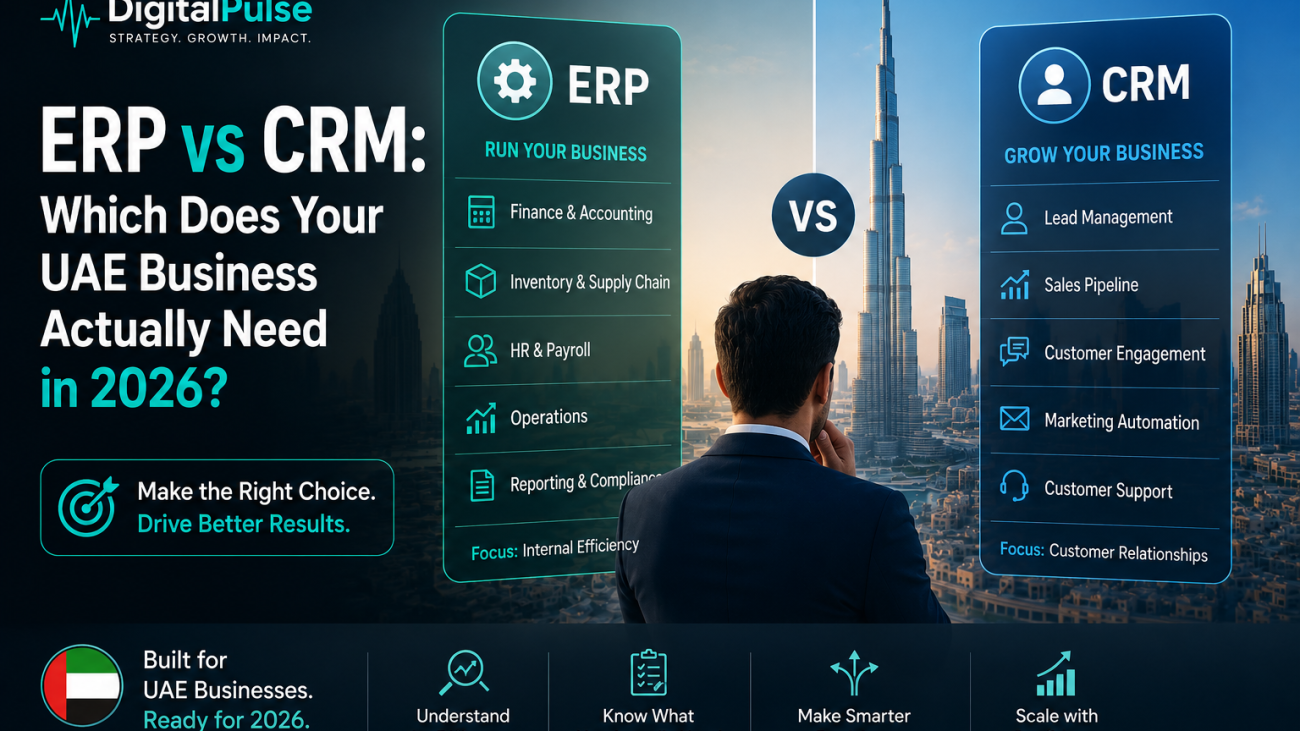
Two of the most commonly confused business software categories are ERP and CRM. Both are described as essential. Both are sold with impressive promises. And for a business owner trying to decide where to invest, both can sound like they do exactly the same thing.
They don’t. Understanding the difference and knowing which one your business needs first, or whether you need both is one of the most practically useful technology decisions you’ll make as a UAE business owner.
This article gives you that understanding, without the sales pitch.
What Is a CRM? (And What Does It Actually Do?)
CRM stands for Customer Relationship Management. Despite the name, it’s fundamentally a sales and customer data tool. A CRM system’s job is to track every interaction your business has with a prospect or customer from the first enquiry through to the closed deal and beyond.
In concrete terms, a CRM helps you:
- Capture and organise leads: Every enquiry that comes in through your website, WhatsApp, a trade show, a referral — is logged in one place with full context.
- Track the sales pipeline: See exactly where every deal stands: new enquiry, proposal sent, follow-up pending, contract signed. Nothing falls through the cracks.
- Automate follow-up: Schedule reminders, trigger email sequences, set tasks for your sales team based on where a prospect is in the pipeline.
- Analyse customer behaviour: Which customers buy most frequently? Which ones are at risk of churning? What’s your average deal size and close rate?
- Manage post-sale relationships: Service tickets, renewal dates, upsell opportunities all tracked against the customer record.
In short: CRM is about the people your business interacts with. It lives on the customer-facing side of your operation.
What Is an ERP? (And What Does It Actually Do?)
ERP stands for Enterprise Resource Planning. Where a CRM faces outward toward your customers, an ERP faces inward toward your operations. Its job is to connect and coordinate the internal departments that make your business run: finance, inventory, procurement, HR, production, and logistics.
In concrete terms, an ERP helps you:
- Manage finances centrally: Invoicing, accounts payable, accounts receivable, VAT reporting all connected to a single source of financial truth.
- Control inventory in real time: Know exactly what stock you have, where it is, and when you need to reorder — across multiple locations if needed.
- Streamline procurement: Purchase orders, supplier management, goods receipt, and payment handled in an integrated workflow.
- Run HR and payroll: Employee records, leave management, timesheet tracking, and payroll calculation in one system.
- Generate management reports: Real-time visibility across every part of the business, without the need to manually pull data from multiple systems.
In short: ERP is the operating system of your business. It connects your internal departments and ensures they’re working from the same data.
The Key Difference in One Sentence
A CRM helps you win and keep customers. An ERP helps you run your operations efficiently once you have them.
They solve different problems. And for most businesses, the order in which you need them depends on where your biggest pain point currently sits.
Which Does Your Business Need First?
Start with a CRM if…
- You’re losing leads because follow-up is inconsistent
- Your sales team has no clear visibility of the pipeline
- You can’t tell which marketing channels are generating revenue
- Customer data lives in spreadsheets, WhatsApp chats, and individual inboxes
- You want to grow revenue from your existing customer base
Start with an ERP if…
- You’re running multiple locations or warehouses
- Inventory errors are costing you money or customer trust
- Your finance team spends more time reconciling data than analysing it
- VAT reporting is a quarterly ordeal rather than a routine export
- You can’t see profitability by product, location, or business unit in real time
You need both if…
- You’re a growing business that has solved the ‘getting customers’ problem and now needs operational infrastructure to serve them at scale
- You’re losing sales because operational failures (stockouts, slow fulfilment, billing errors) are undermining the customer experience your sales team is working hard to create
- You want a single view of the business — from first customer contact through to delivery, invoicing, and after-sales service
How Integration Changes Everything
Here’s why the most progressive UAE businesses are moving toward integrated CRM and ERP: when the two systems share data, the business intelligence you get is in a different category altogether.
Imagine a customer places an order through your sales team (CRM). That order automatically creates a fulfilment task in your ERP, triggers a stock reservation, generates a VAT invoice, and logs the transaction against the customer’s revenue history. When the customer calls to follow up, your sales team can see the order status in real time without calling the warehouse.
This isn’t science fiction. It’s what integrated systems deliver. And in a competitive market like the UAE, businesses running on connected data make faster, better decisions than those managing disconnected spreadsheets and siloed software.
ACTION: Digital Pulse provides CRM, ERP, and integrated business software solutions tailored for UAE businesses. Not sure which you need? Book a free 30-minute consultation at getdigitalpulse.com and we’ll help you decide.